
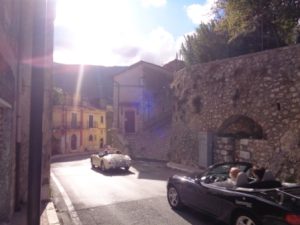



CAPISTRELLO
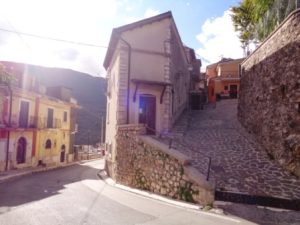
Scorcio di Capistrello oggi. (Immagine personale)
What to do in Capistrello? The answer is simple: there’s so much to do, you’re spoiled for choice. Capistrello has so much to offer in terms of culture and nature.
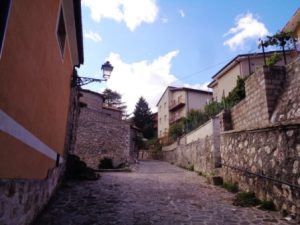
Scorcio della parte antica di Capistrello. (Immagine personale)
Let’s begin with a cultural perspective, imagining a historical tour through the narrow streets of the old town around the Church of St. Anthony of Padua. Here we find what remains of the medieval-Renaissance village, with its narrow, steep streets, constantly alternating up and down.
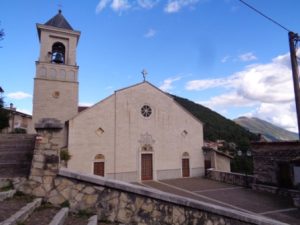
La chiesa di S. Antonio da Padova a Capistrello oggi. (Immagine personale)
Today the village no longer has its castle, which apparently disappeared after the Gioia dei Marsi earthquake of 1915, but it still retains a good historic center, which is worth discovering starting with its historic churches such as the church of S. Antonio da Padova, dating back to the 12th century, or the church of the Madonna dell’Assunta, dating back to the 12th century as its first construction, but the current religious building dates back to the early 17th century.
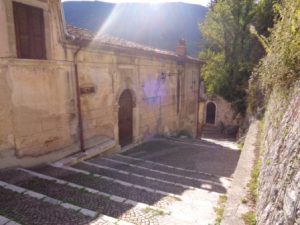
Scorcio della parte antica di Capistrello. (Immagine personale)
In addition to the churches in the old town, there are also several ancient buildings dating back to the 16th century, such as Palazzo Lusi, an imposing Renaissance palace.
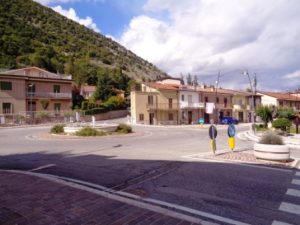
Scorcio di Capistrello nella zona moderna. (Immagine personale)
Moving into the modern part of town, we find a new town, with wide streets and a cluster of well-maintained houses. This is complemented by a series of monuments that recall the town’s modern history over the last 150 years. Among these, the beautiful Shrine of the 33 Martyrs of Capistrello, built in 1963, is worth a visit. It commemorates the massacre of 33 young shepherds brutally murdered by the Germans in early June 1944.
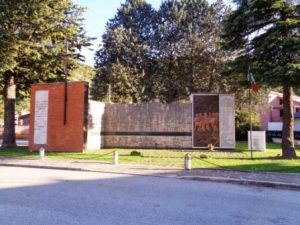
Sacrario a ricordo delle vittime del massacro del
giugno 1944. (Immagine personale)
After visiting the village, you can continue with a visit to the final section of the Torlonia emissary, located in the Capistrello area. It was renovated in the second half of the 19th century by the banker Torlonia during the construction of the new conduit, but it follows the Roman conduit of Claudius.
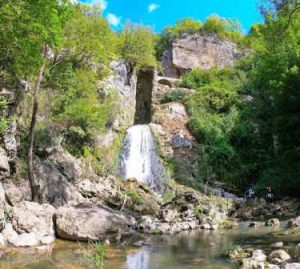
Cascata delle acque del bacino fucense che si
gettano nel Liri dopo la traversata sotterranea,
dopo essere passati all’interno dell’emissario Torlonia.
This extraordinary hydraulic work can be admired by descending towards the Capistrello Gorge, and is particularly noticeable because in spring and autumn it forms a small waterfall, corresponding to the waters of the Fucino basin flowing into the Liri River. This is a truly breathtaking spectacle, whose beauty will leave you speechless.
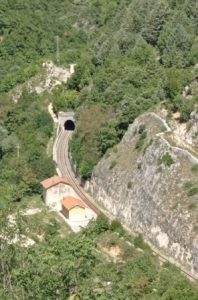
Tratto ferroviario del sistema elocoidale di
Capistrello della Ferrovia Avezzano – Roccasecca. (Immagine personale)
If you want to experience the charm of a major hydraulic engineering feat, I recommend taking one of the trains to Roccasecca in Lazio. Board the train and travel two stops, getting off at Pescocanale. While on this train, you’ll experience the charm of the helical tunnel, one of the most beautiful railway structures in central Italy.
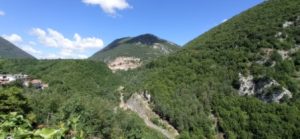
La gola di Capistrello vista da Pescocanale. (Immagine personale)
Once you reach Pescocanale, climb up to the village and from the lookout point near the village church, admire the charm of this gorge, not only for the railway, but above all for its natural beauty. The Capistrello Gorge is one of the most beautiful attractions in the entire Marsica region, yet it’s rarely talked about. If you find yourself on the trail from Capistrello to the Claudio-Torlonia effluent waterfall, admire the sheer rock walls along this stretch of the gorge. It’s impossible not to be captivated.
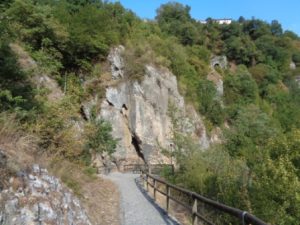
Le pareti di roccia calcarea della gola di Capistrello. (Immagine personale)
Aside from the Capistrello Gorge, if you want to immerse yourself in the nature surrounding the town, I recommend wearing comfortable shoes and going hiking around the village. You’ll discover breathtaking nature as you explore the mountains and plateaus in the area, such as the Renga Plateau.
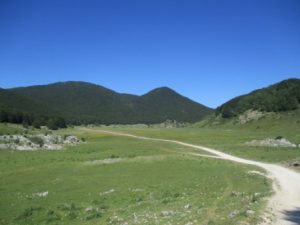
Altopiano della Renga. (Immagine da Wikipedia)
This plateau is a karst plateau formed by tectonic sedimentation over geological time. This area is characterized by a splendid, ancient forest and a beech forest at 1,700 meters above sea level. Ideal for picnics, it’s a perfect place to relax and enjoy company. It’s no coincidence that this is one of the most popular areas for vacationers and residents of Capistrello.
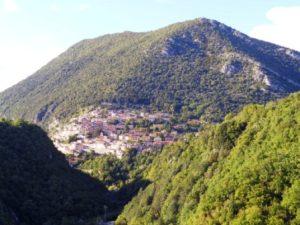
Capistrello posta sul lato meridionale di Monte Arezzo. (Immagine personale)
But excursions to discover the breathtaking nature around Capistrello don’t end with the Renga plateau. If you wish, you can continue through the surrounding mountains, rich in pristine nature, streams flowing from small local springs, and unexpected encounters with history found in the mountains around Capistrello, starting with Monte Arezzo, below which Capistrello is located on its southern side.
Mount Arezzo is a Site of Community Interest and, together with Mount Aurunzo, forms a small ridge separating the Liri Valley from the Imele Valley and thus the Piana Palentini. Starting from Capistrello, you can embark on a mountain and nature trail that crosses much of the municipality of Capistrello.
Starting from the village, the trail ascends along Monte Arezzo, passing through beautiful forests of flowering ash and hornbeam, to the summit at 1,267 meters above sea level. Here, you’ll find the ancient sanctuary of the church of Santa Maria del Monte. Continuing, you traverse the ridge for about an hour, through the Pagliara Pass into the neighboring municipality of Castellafiume.
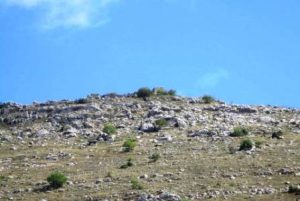
Resti del castello medievale di Girifalco. (Immagine
da https://www.facebook.com/photo/?fbid=183067564108527&set=a.300225369059819)
At a certain point, you reach the summit of Monte Girifalco, where the remains of the medieval fortress of Girifalco are located, one of the most important castles of the medieval period between the 11th and 15th centuries. From here, you descend slightly below the former castle, arriving at the Grotta di San Lorenzo, a karst cave that served as a hermitage in the Middle Ages, linked to the ancient monastery of San Pietro di Corcumello and likely served as an air raid shelter during the Allied bombings of World War II, as well as a possible refuge from Nazi barbarians.
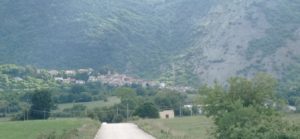
Il paese di Corcumello oggi. (Immagine personale)
Then, continuing down the ridge, you finally arrive at Corcumello, one of the two hamlets of the municipality of Capistrello. This town is one of the richest in history in the entire Marsica region, home to a large medieval-Renaissance castle, little-known even in the Marsica region. Above all, it retains all its medieval charm, with its narrow streets constantly zigzagging up and down.
If this isn’t enough for you, you can explore the area around the hamlet of Corcumello, where there are traces of two fortified Marsi settlements: one in the Civita di Fossa Rotonda area at 1,213 meters above sea level, and the other in the Rotella di Collalto area.
From the Roman era, we know of the presence of the great Claudian emissary, whose mouth onto the Liri River remains unchanged from 2,000 years ago, although renovated in the 19th century with the construction of the new Torlonia emissary. Also from the Roman era are the remains of a Roman vicus in Grottella, at an altitude of 750 meters, while the remains of several Roman country villas have been found in the Piani Palentini between Cese and Corcumello.
So, in Capistrello, it’s hard to get bored, but it’s easy to have diverse, educational, and rejuvenating experiences. So what are you waiting for? Come to Capistrello!!!