
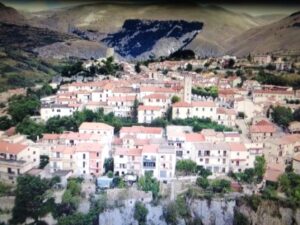


Aielli has always been considered the balcony of the Marsica, due its high position directly overlooking the Fucino plain. Aielli is in fact with its 1021 m. one of the hightest and mostpanoramic villages in the whole Avezzano area and includes two residential areas, Aielli Alto (seat of the Town Hall) located at 1021 m. and Aielli Station located lower at 782 m.
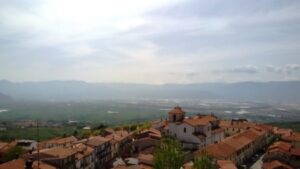
Panorama del Fucino da Aielli. (Immagine personale)
The panorama that can be admired from Aielli is made even more suggestive when you look out from the town towr located in the highrdt part of the old residential area.
On the geological-structural level Aielli Alto lies on a limestone rocky spur, which is part of the Sirente mountain range and is located north of the Fucense plain.
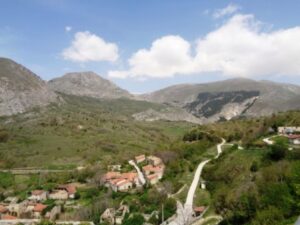
I monti che circondano Aielli. (Immagine personale)
The Sirente chain surrounds the village of Aielli Alto with some of its mountains (M Etra, M. Secine and M. San Pietro. From these two streams arise that bypass the rocky spur on which the town is located and converge further downstream to flow into the Fucense plain.
On the geological-stratigraphic level the town is located on a soil for the most part calcareous, even if there are areas with different lithology. Le Foci area with bitumen, or like the La Liscia area where there are high concentrations of fossiliferous limestones of marine origin, such as the many calcified shells found in the area.
Another important geological feature of the Aielli area concerns the Celano gorges. These are a real canyon, one of the most evocative of the whole Apennine chain, which we will talk about extensively elsewhere.
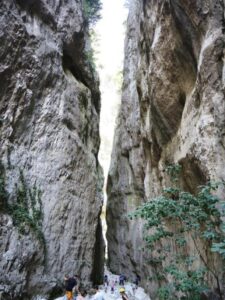
Le Gole di Celano. (Immagine da Wikipedia)
For now we will limit ourselves to saying that these gorges have been dug over time by the Rio La Foce, which penetrates beyond the Val d’Arano di Ovindoli and which with its erosive action separates Monte Tino from Monte Sirente. Well, access to this great limestone canyon takes place right in the municipality of Aielli. To be more precise, access to the gorges is at the locality of Bocca di Castelluccio di Aielli located at about 900 m a.s.l.
Now its geological wealth certainly makes it a real treasure for geologists and mountain enthusiasts, which however includes much more. Its dominant and strategic position made it in Roman and medieval times a particularly suitable place for the defense of the territory and the observation of communication routes.
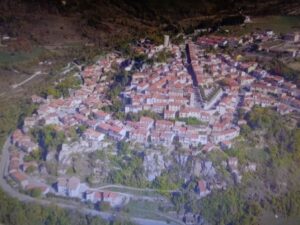
Aielli vista dall’alto. (Fermo immagine da video YOUTUBE)
From this originated at the beginning only a military observation post of the territory and then in medieval times this position evolved into a tower around which the village of Aielli was born between the 10th and 11th centuries. Over time Aielli has been alternatively both a small independent fiefdom and part of the larger Celano county. Then in the 19th century with the feudal subversion it became a municipality in the Avezzano area, which in 1915 was destroyed by the Gioia dei Marsi earthquake.
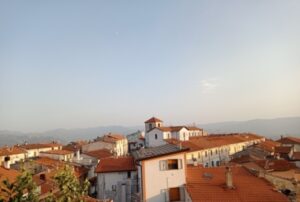
Il paese di Aielli. (Immagine personale)
day the village of Aielli after the terrible earthquake of 1915, is completely rebuilt and functional, moreover in recent years it has also been reborn on a cultural level, becoming an important international center of Street Art.
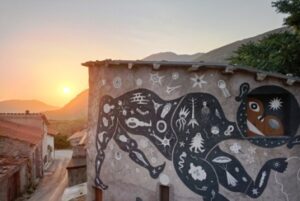
Uno dei Murales del paese di Aielli. (Immagine personale)
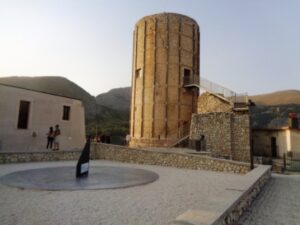
L’osservatorio astronomico di Aielli. (Immagine personale)
In addition to this Aielli is also famous for the presence of an important astronomical observatory, based in the medieval tower, the Tower of the Stars, where tens of thousands of visitors flock every year to learn the secrets of the cosmos.
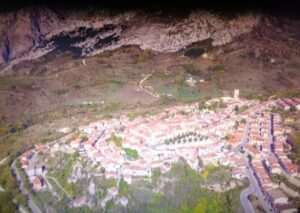
Aielli vista dall’alto. (Fermo immagine da video YOUTUBE)
Thanks to the substantial Marsican cuisine, in recent years the small village has also become one of the most popular destinations in Abruzzo for tasting the rich dishes with a typically mountain flavor, which can be tasted immersed in a village with a typical medieval imprint.
With this follows the invitation to visit the Aielli, savoring all its nuances which are different depending on the season in which you visit the village.