
– 
– 
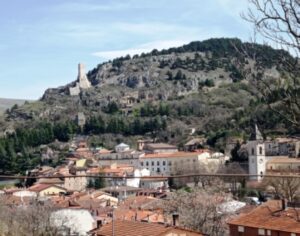
Pescina is a town in the Marsica region with about 4000 inhabitants, easily reachable from the A25 motorway and set in an environment of great respect for its beauty and history. And its history is one of the distinctive features of this small town in the Marsica area.
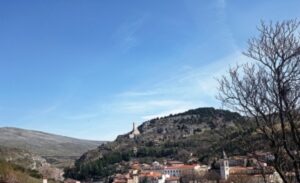
Pescina oggi. (Immagine personale)
In fact, the story here speaks for itself and it is sufficient to walk the narrow streets of the town to realize it in the continuous ups and downs of narrow streets and alleys. This is in fact a country with an enormous history behind it, which has left ample traces of its historical course, despite the immense destruction it suffered on 13 January 1915 due to the earthquake of Gioia dei Marsi.
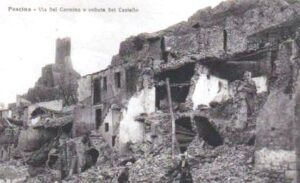
Pescina l’indomani del sisma di Gioia dei Marsi nel 1915.
The Gioia dei Marsi earthquake is an extremely strong earthquake equal to 7 Mw, which hits Pescina and the Marsica hard, somehow causing a historical caesura from which the territory recovered only after 100 years. And here in Pescina the Gioia dei Marsi earthquake was particularly violent causing the death of 5,000 people out of a total of 6,000 inhabitants and the complete destruction of all the buildings and monuments of the town, churches in particular.
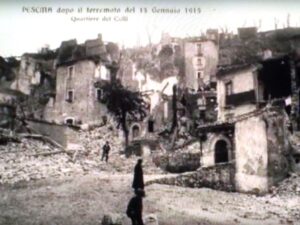
Pescina l’indomani del sisma di Gioia dei Marsi nel 1915.
When the earthquake occurred in 1915, the assistance for the earthquake left only in the late evening of 13 January 1915 and arrived only in the morning of 14 January and this due to the impassability of the roads and the landslides caused by the huge shock. The earthquake of Gioia dei Marsi was so destructive as to destroy most of the towns and municipalities of Marsica. In practice it is a huge ruin. In the same period of the earthquake we already have the First World War underway and this in the end also absorbs Italy which enters it during 1915 alongside the Entente.
The tragedy of war therefore adds up to the local tragedy of the earthquake, as many of the children who survived the earthquake are forced to leave for the front, taking away valid support from the already severely deprived families.
Only a few people remain in the Marsica to help the survivors, who have to resist alone for some time, then later the prisoners of war sent to Avezzano help the various towns in a slow reconstruction. Reconstruction that takes place amidst the multiple mourning of the Abruzzo boys who died in the meantime on the Alpine front. For the surviving population it is hard and heavy.
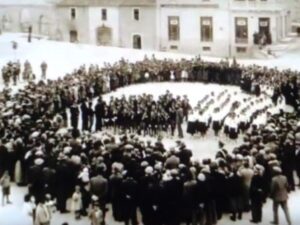
Pescina durante una manifestazione fascista degli anni ’30
Years go by and Fascism arrives under which the reconstruction of the inhabited centers including Pescina is carried out. Well, we have ample traces of this period in the Marsica in the constructions, above all of various monuments and from this period we have one film in particular that tells the local history of those years, referring entirely to the novel by Ignazio Silone set in the Marsica of the fascist period.
Well, this 1979 film is a perfect photograph of the area in this era and of the way in which the population had to adapt to living under Fascism which brought so much suffering, albeit mixed with a politics of power, which tended to confuse reality for the population. In 1939 World War II broke out and in 1940 Italy entered the war alongside Germany. The next disaster is worse than World War I. Fascism collapses and there is the German invasion that brought so much suffering, finally the liberation in 1944 and the return to normalcy in 1945-46.
But the suffering and difficulties experienced during the fascist occupation and above all the sense of mourning that had not yet passed in 1945 for the 1915 earthquake, prompted the population to seek a remedy in the hope of the future on which everyone has been committed over the decades subsequent.
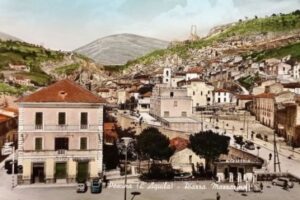
Pescina nel 1950.
The work done by the citizens to relaunch the country is very difficult due to the economic difficulties that are driving part of the population to emigrate, but those who remain believe in it and work hard up to the Marsican economic boom of the 80s and the following revitalization of the towns in the area, its tourist front.
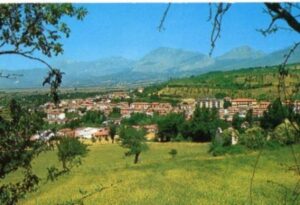
Pescina negli anni ’80
Well, all this historical preamble serves us to say that there has been a lot of history and effort in the Marsica and there is a lot of it and the monuments and villages restored in recent decades demonstrate how much pride and passion there has been on the part of the population to relaunch on a touristic level, but above all on a social level.
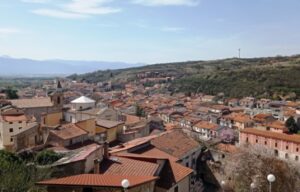
Pescina oggi. (Immagine personale)
Visiting and admiring Pescina today means precisely this retracing a history and traditions that smack of the ancient, but also of strength in being able to grow socially in the most extreme difficulties such as the 1915 earthquake may have been.
Today Pescina is an agricultural center of primary importance being one of the major goods sorting centers for fruit and vegetables from the nearby Piana del Fucino. But Pescina today is also a large tourist center with its own museums and cultural trails. The cultural itineraries that can be found in Pescina are many and range from the religious to the historical-political sphere.
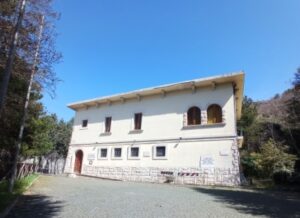
Casa Museo Mazzarino. (Immagine personale)
In Pescina we find two important museums, one dedicated to Cardinal Mazarino 1 French minister under Louis XIV and the other to Ignazio Silone one of the greatest Italian men of letters of the 20th century. The figure of Mazarin is widely described and venerated in France, where he lived and made a career both on a religious and political level, but not everyone knows that he was born in Pescina. Pescina has dedicated an entire museum to them in the same place where until 1915 his birthplace, which collapsed in the earthquake, stood.
Mazarin was a fundamental figure for Louis XIV as the young king lost his father at the age of 5 in 1643, ended up under the protective wing of the great cardinal, whoprotected and supported him as a father does until his death. in 1661. Well, in the museum dedicated to Mazarin the story of his childhood lived in Pescina is reconstructed in some way.
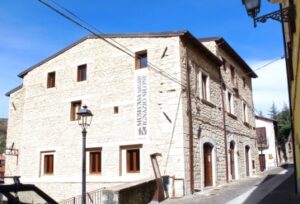
Casa Museo Ignazio Silone. (Immagine personale)
The other important museum in Pescina concerns Ignazio Silone, a great writer and politician of the twentieth century, closely tied to his native town, Pescina. The museum dedicated to Silone is located in the writer’s birthplace which miraculously survived the 1915 earthquake and was used as a museum in 2021.
However, we must point out that a part of the museum dedicated to Silone is also present at the Teatro San Francesco in Pescina. Also noteworthy is the tomb of Silone which is located at the foot of the old church of San Berardo, from which one of the most beautiful panoramas of the Marsica can be enjoyed.
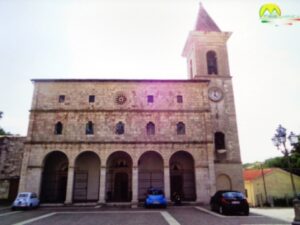
Basilica di Santa Maria delle Grazie. (Immagine personale)
On the religious level we have the basilica of Santa Maria delle Grazie (16th century), an ancient cathedral of the diocese of the Marsi, which contains the remains of San Berardo, the patron saint of the Marsican territory.
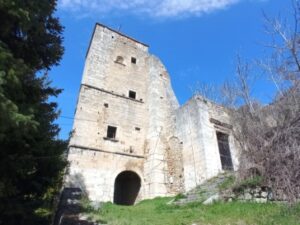
Resti della chiesa di San Berardo. (Immagine personale)
In addition to the basilica of Santa Maria delle Grazie there are other important churches such as the 12th century church of S. Antonio da Padova located in the old part of the town, the ancient 12th century church of San Berardo awaiting destoration, and the church di San Giuseppe built after the earthquake of 1915, noteworthy for its elegant and refined structure.
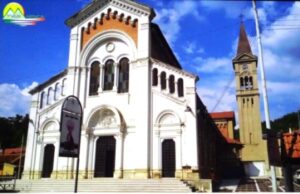
La chiesa Giuseppe. (Immagine personale)
On the civil level we find several important monuments among which the various fountains present in Pescina stand out such as the Fontamara fountain, which became famous with the film of Fontamara by Silone in 1979, the 1934 fountain, a splendid example of fascist art, the old fountain, found at the exit of the town going towards Valle del Giovenco and the fountain of the Madonna del Carmine present in the oldest part of the town.
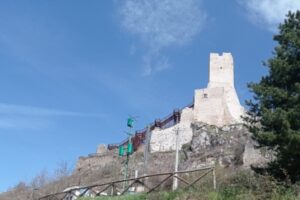
Il castello di Pescina dopo il recente restauro. (Immagine personale)
Finally, to all this is added the medieval castle of Pescina, located at the top of the town in an impervious position and controlling the passage towards Valle del Giovenco. The old castle, very recently well restored, offers a spectacular view over the Valle del Giovenco and the Piana Fucino. For anyone who looks at it from below, the castle makes a fine show of itself over the town with its proud and independent character.
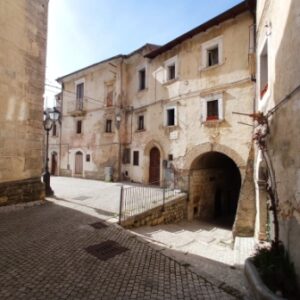
Centro storico di Pescina. (Immagine personale)
Around the old castle it is possible to notice the whole old village which after 100 years has been almost completely restored and offers with its houses a cross-section of the life of the past and of the progress of history.
However, in addition to the historical and cultural part, Pescina offers above all a magnificent natural environment in which to immerse yourself in order to find yourself and recover. The natural environment in which Pescina is immersed can be visited both inside and outside the town.
In fact, inside the town it is possible to admire the course of the Giovenco River where, near the entrance to the Valle del Giovenco, there is a small artificial lake, where it is possible to go fishing, but above all to stay in peace.
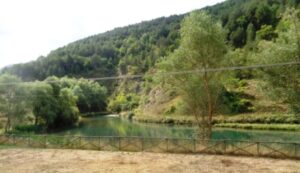
Laghetto artificiale del Giovenco presso Pescina. (Immagine personale)
Externally, Pescina is a good starting point for discovering the surrounding area both towards the Piana del Fucino and towards the Valle del Giovenco, both are magical areas in which to get lost completely.
PESCINA
__________________________________