
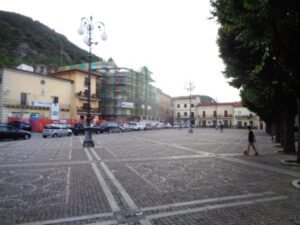


Luco dei Marsi is a town in the Marsica area on the southern slope of the Fucino plain. Until about 1870, the town overlooked an expanse of water such as the Fucino, being the third largest lake in Italy until the mid-19th century.
After its disappearance due to the drainage carried out by the banker Torlonia, the lake has become a large and very fertile plain. Well, on this plain there are various villages, including Luco dei Marsi, which was initially a lakeside town and after drying up it has become a large agricultural center.
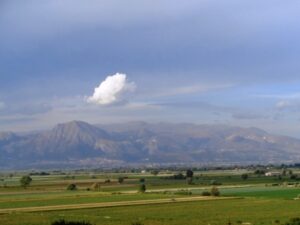
Piana del Fucino vista da Scurcola. (Immagine personale)
Today Luco dei Marsi is a town dedicated to agriculture in the Piana del Fucino and to industry that has been developing at the same time as improved agricultural techniques. At the same time Luco dei Marsi is increasingly acquiring a position as a tourist town, improving its receptivity and cultural offer, exploiting in this sense the long history it has behind it.
The town was founded about 2500 years ago, first inhabited by the ancient Marsi, who elected the area as their maximum cult zone, where the most important goddess of the area resided, namely the goddess Angizia, who lived in her sacred wood and who from here he somehow led the ancient people of the Marsi. Of this ancient history today the ruins of the cult area with its magnificent temples are preserved, it is the acropolis of the Italic-Roman city of Anxa-Angitia.
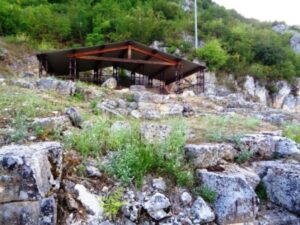
I templi di Luco dei Marsi, l’antica acropoli di Lucus Angitiae. (Immagine personale)
In this city in the imperial age, the slaves and soldiers involved in the construction of the Fucino emissary, wanted by the emperor Claudius and then perfected under the emperors Traiano and Adriano, stayed there among others.
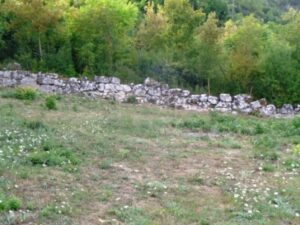
Le antiche mura di Lucus Angitiae. (Immagine personale)
In addition to the cult area, the ancient walls also remain of the ancient Italic-Roman city, a true jewel of history. However, Luco is a village that was established in the Middle Ages and there is traces of this in its historic center, which has terraced alleys that descend towards the bed of the former Fucino lake and which preserve the memory of the town as a lakeside village dedicated to fishing. In fact, Luco up to the last century had a small port for the boats that went into the lake to fish.
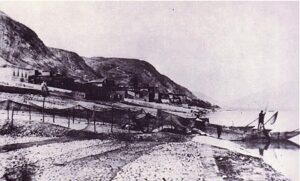
Immagine del porticciolo di Luco dei Marsi a metà 800.
As mentioned Luco after the drying up of the lake has become a large agricultural center, where many seasonal workers dedicated to agriculture reside in the Fucino area, but as mentioned the town is becoming a decent tourist village, always presenting itself at its best through constant care of its center. historical and its territory in general. The town in fact has important environmental characteristics that allow it to offer various activities both to those who live there and to those who visit the village. Luco is located in an uncontaminated mountain environment, which is gradually being equipped to make the most of it. The municipality has within it the San Leonardo Park and the Selva dei Frati which have been largely taken care of to be exploited for both tourism and sporting purposes.
Luco dei Marsi is therefore a country to be discovered and admired for its enormous history with 2500 years under its belt and to be admired for the many beauties it possesses and which in part are still to be perfected for tourism.
LUCO DEI MARSI
___________________________
VISITARE LUCO DEI MARSI
___________________________