
– 
– 
Aielli is a town full of numerous attractions, starting with the naturalistic part that has very particular implications starting with the Celano Gorges, a real canyon, one of the most beautiful and majestic of the entire Apennine chain.
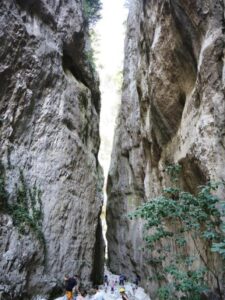
Le Gole di Celano. (Immagine da Wikipedia)
This canyon is the result of a millenary erosion of the La Foce stream, which over time separated Monte Tino from Monte Sirente. Regarding the canyon in the municipality of Aielli we find here its access present at the locality Bocca di Castelluccio di Aielli located at about 900 m s.l.m. In addition to the canyon, the territory of the municipality of Aielli presents numerous other natural attractions such as the beautiful mountains that frame the municipality of Aielli Alto. From Aielli Alto it is in fact possible to easily leave for excursions on these mountains which are also very rich in historical remains.
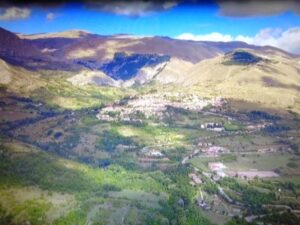
I monti che circondano Aielli. (Fermo immagine da video Youtube https://www.youtube.com/watch?v=GaUjqwR2aLk)
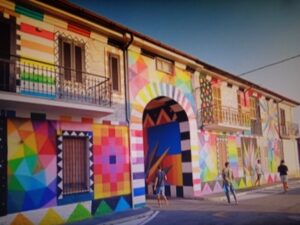
Instead, the excursion to the village of Aielli Alto represents a real journey in different eras placed in contact with each other, ranging from the Street Art of the 21st century to the medieval era with its buildings and structures. Entering the village of Aielli you immediately perceive an atmosphere of old and new fused together and this is felt by the immediate observation of the numerous Street Art paintings present everywhere, together with the old buildings of the village.
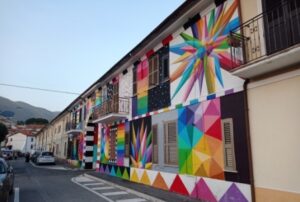
La Street Art ad Aielli. (Immagine personale)
The Street Art paintings made on the facades of the Aielli buildings have made the village famous internationally and have decorated it splendidly since 2017. In addition to these we find the beautiful medieval tower which since 2002 is home to a prestigious astronomical observatory, visited every year by many people.
The tower erected in the fourteenth century is still standing and with its presence represents one of the symbols of the municipality of Aielli. Inside the tower there is also a museum dedicated to the sky and a scientific library.
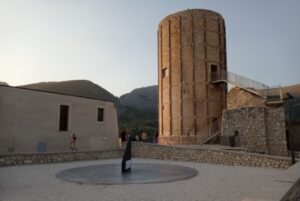
La Torre delle Stelle, osservatorio astronomico di Aielli. (Immagine personale)
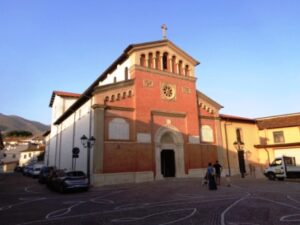
La chiesa della Santissima Trinità. (Immagine personale)
Like any self-respecting village, this one also has its own churches, which are true treasures of art. The earthquake of 1915 destroyed the previous religious structures, which have however been faithfully reconstructed to the originals. The first church we consider is the church of the Holy Trinity, located in the center of the town and dating back to 1362.
This was destroyed in the earthquake of 1915, and was then rebuilt in the 20s of the twentieth century in a very faithful way to the previous structure.
Moving to another area of the historic center of Aielli we find the church of San Rocco dating back to 1545. This church dedicated to the patron saint of the town was used in the mid-seventeenth century for the hospitalization of plague atients, parallel to the hospital of the town of the time . of S. Maria della Pace located in the locality of Bovezzo.
Speaking of churches, you cannot miss a visit to the church of S. Giuseppe, located in the lower center of Aielli Stazione. This monumental church built in 1937 represents one of the greatest expressions of fascist architecture produced here in the Marsica.
The church was initially dedicated to S. Adolfo, but then over the decades it was renamed to San Giuseppe. The church is particular for its Latin cross shape with a central bell tower decorated with a stained glass window with organ pipes. To this are added the polychrome marble of the floor and the wonderful stained glass windows depicting the Via Crucis.
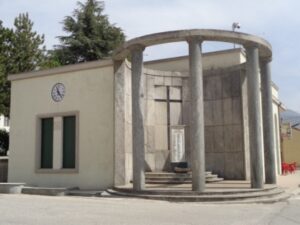
Sacrario di Aielli Stazione. (Immagine personale)
Leaving the church of San Giuseppe you can see the Shrine, also inaugurated in 1937 and an expression of Fascist architecture like the church opposite. The village of Aielli Stazione, which came to life from scratch within a few years, especially after the earthquake of 1915, initially had an irregular urban structure, but the ability to rethink the village in the Fascist era then further improved in subsequent eras has allowed this to grow more smoothly and precisely.
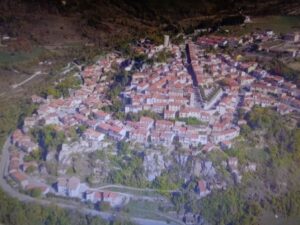
Il borgo di Aielli. (Fermo-immagine da video Youtube https://www.youtube.com/watch?v=6ZjPHmE6J7Q)
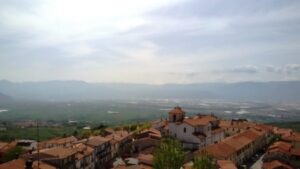
Aielli. (Immagine personale)
The architectural complex of Aielli alto and Aielli Stazione, while not appearing among the first models of urban structure, nevertheless accurately represents the architectural evolution of the Marsica villages. In fact, due to the disastrous earthquake of 1915, they had to abandon the old villages to erect new ones, however the great resilience of the ancient villages took place between the end of the twentieth and the beginning of the twenty-first century, has allowed and is allowing new villages to better complement each other as urban structures, evolving over time into a single large agglomeration, which comes to contain the oldest and the most modern part without distinction between the two urban systems and this also in consideration of a certain distance between them .
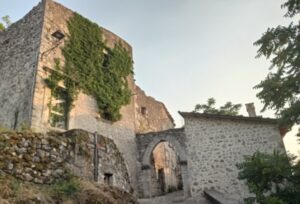
Aielli – Porta Montanara. (Immagine personale)
Well in this sense Aielli seems to represent the serene evolution of a new model of urban development in the Marsica which, recovering its old part, proves to have the strength to better organize the modern part as well. Well, a visit to these two villages proves to be very useful for understanding the great development capacity of this land, which alone was able to face the tragedy of the earthquake and was able to get up again, putting itself on a par with the most modern areas of the country.