
– 
– 
If we ask ourselves what Luco dei Marsi offers to admire, we might be surprised by the many and small peculiarities that the town and more generally the municipality offer.
Starting from the town you immediately notice its mountains, which seem to fall on the town. In part this is also true, given that there are several landslide risk points, but in general the municipality and therefore the country, being at the center of the large natural parks of the Marsica, can be considered the starting point for numerous naturalistic excursions, valid both for the municipal area than more a general for the Marsicana area.
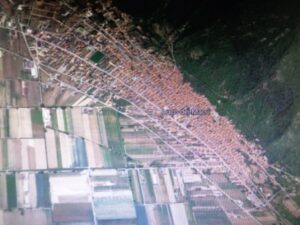
Luco dei Marsi in un immagine di GoogleMap
Surely, however, the strong point of the town is its history, which is expressed cell in its monuments starting with the archaeological ones of the temples of Angizia. These temples represent the acropolis of the Italic-Roman city of Anxa-Angitia, of which there are also large sections of walls, which alone represent and tell a historical reality of great importance.
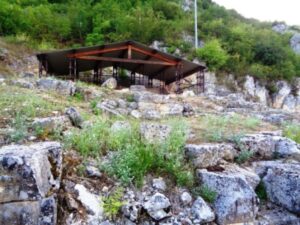
L’area archeologica dei templi di Lucus Angitiae. (Immagine personale)
If we then turn our gaze to the medieval period, we find several surprises in its historic center starting with the stepped structure, which represents the trend of the old village when Lake Fucino still existed. This represents an invitation to visit Luco also on the urban plan.
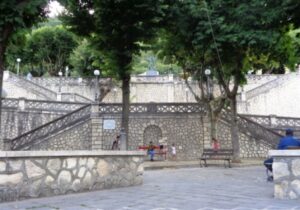
Scalinata del centro storico di Luco che rappresenta l’antico livello del lago Fucino che raggiungeva in tempi di esondazione il centro del paese. (Immagine personale)
Various monuments have been preserved from the medieval period, starting with several houses in the historic center, which have maintained the structure of the past and are therefore worth a visit. In addition to this we find the church of Santa Maria delle Grazie and the Capuchin convent which refers to the church of San Sebastiano.
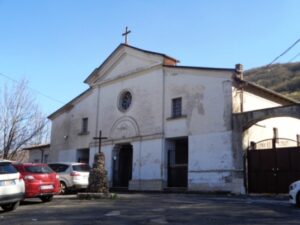
Convento dei Cappuccini a Luco dei Marsi. (Immagine personale)
The ancient convent, although extinct on the convent level, has nevertheless remained a place of prayer and hospitality for those who come to the country to spend a few days of relaxation, to find themselves or simply to have a different experience. What is certain is that staying in Luco dei Marsi also means being able to experience the festivities and the atmosphere of the town, through participation in the numerous initiatives organized by the local community.
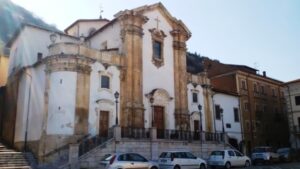
Chiesa di San Giovanni Battista di Luco. (Immagine personale)
Coming to the following periods we find two other important churches, namely the church of Sant Antonio Abate and the church of San Giovanni Battista, the first of the sixteenth century and the second of the eighteenth century respectively. These two religious structures have retained important traits of the art and culture of the construction period.
Still on the subject of churces, we also point out the church of the Madonna dell’Ospedale built in the 70s of the twentieth century and which over time has become an important point of reference for the Luquois.
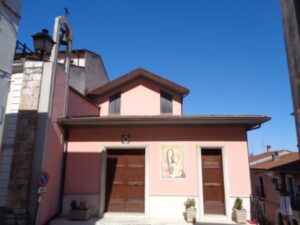
La chiesa della Madonna dell’Ospedale. (Immagine personale)
The above refers to the main monuments of the town of Luco, but alongside these there are others recently added, which manifest the tradition of the village expressed in a modern key. Of course, the town of Luco dei Marsi is now entering the tourism sector, so it needs time to adapt to this context and be able to compete with the rest of the towns in Marsica and Abruzzo more generally.
LUCO DEI MARSI
___________________________
VISITARE LUCO DEI MARSI
___________________________